

.png)
About Us
The Horticultural Society has been established in one form or another since 1887 and is probably best known locally for organising the traditional annual show, held at the Amalgamated Sports Club in Disley village.
Over the years we have hosted many memorable shows and events, have a look at our history section below for more detail.
This year we will be holding our 119th show and, although we have changed and adapted some of our content to encompass the changes of modern society, our core aim remains the same; to provide a traditional show for the local community. Our mission is to encourage people of all ages to participate in the pleasures and rewards of everything associated with gardening and related activities.
Check out our events page for the latest news of upcoming trips, talks and events.
Objectives of the society
Improve horticultural knowledge and interest
By arranging lectures and discussions on gardening and kindred subjects
Encourage the advancement of horticulture
By promoting shows and exhibitions of plants, flowers, fruit and vegetables
Arrange visits to gardens, parks and other places of interest
To improve horticultural knowledge and experience.
Brief History of the Disley & Lyme
Horticultural Society Show
Having origins in the agricultural shows of Disley, Lyme Handley, Shrigley, Marple and Norbury, dating from 1848, the Disley and Lyme Horticultural Shows of today have gone through many changes and have been held at quite a few different venues in the intervening years. Abandoned at times, due to world wars and foot and mouth outbreaks, there has always been a will amongst the local community to revive the annual show; a day of fun, competition and entertainment, enjoyed by all.
The early agricultural shows of the 1840’s and 1850’s, held on grounds connected to the Ram’s Head, were a far cry from their later counterparts. With an emphasis on agricultural produce, farming skills and demonstrations of new farm implements, they were generally held on a Thursday in September. Entertainment was provided by Disley Band and Morris dancers.

1851 Lyme Park Agricultural Exhibition
The 1860’s saw a move to Lyme Park, where the billing had changed to ‘Floral, Horticultural, Agricultural Show with Field Produce’. This type of event continued into the 1880’s, with brass bands still supplying a festive soundtrack and donkey races adding fun and merriment to the occasion.
Queen Victoria’s Golden Jubilee year of 1887 saw the birth of the Horticultural Show. Advertised as ‘Disley Jubilee Flower Show’ it was held in a tent near what used to be the Ring o’ Bells Coffee Tavern. The following years’ shows returned to Lyme Park on the third Saturday in August, under the name of ‘Horticultural Show and Athletic Sports’. Visitors also benefited from free access to the gardens and kennels at Lyme. During the late Victorian era, the exhibits of flowers, fruit and vegetables increased in number and significantly improved in quality year on year. The sport element also continued to play a big part, as did the brass band contests.
As we move on to the Edwardian period, things remain much the same, with ever increasing crowds and a great deal of enthusiasm from attendees. Sadly, this was to come to an end with the outbreak of World War One, when the show was suspended for ten years.
1924 marked the return of the show, again held in Lyme Park. Festivities did, however, continue elsewhere for those who were not able get to the showground. A group of children from Disley school were met at the White Lion by New Mills Band and together they played and danced to the Ram Green, where, after much practice, the youngsters danced round a maypole. A new attraction of sheep dog trials made its first appearance at the 1929 show and, proving very popular, continued until the further suspension of the show in 1940, due to the Second World War.

Prizes as part of the 39th Annual Show, 1935.
The 43rd Annual Show in 1939 was the last before World War 2.

The show resumed once more in 1949, enjoying a new venue at Park Field, Red Lane, Disley and by the early 1950’s the name Disley and Lyme Horticultural Society had appeared. The ever-popular sheep dog trials had returned after the break and continued until 1951 when, the following year, they were replaced by a pony gymkhana. The athletic races and displays still featured prominently and further sports were added, including a boxing tournament and judo demonstration. A shortage of funds and the death of the show secretary led to the cancellation of the show in 1958.

Judging at the 48th Annual Show, 1953.
Between 1959 and 1989, the show was held indoors at St. Mary’s schoolrooms, but moved to Disley Primary School in1990, where the playing field allowed the return of outdoor activities and the construction of a large marquee, to house competition classes and displays of garden produce. From then on, there was much more emphasis on horticulture, including exhibits of orchids, bonsai and cacti.
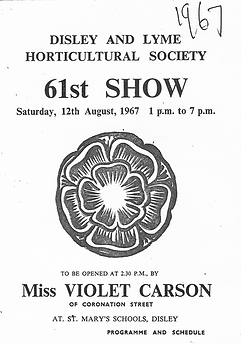


Annual Show programmes through the years.

1980


1980
From 2004, the show venue moved, yet again, to its current location at Disley Amalgamated Sports Club and continued to develop and evolve into the much-loved event that we all enjoy today.
Joan Morris